
Vinyl vs Fiberglass Windows in a Cold Climate: What Makes Sense in the Black Hills
If you are pricing replacement windows in Rapid City, the first big choice is usually the frame: vinyl or fiberglass. Vinyl is the most common replacement window sold and costs less. Fiberglass costs more, moves less with temperature, and tends to come in slimmer, stiffer frames. Both can work well here. The right pick depends on your budget, how long you plan to stay, the size and color of the windows, and how hard your house gets hit by sun, wind and cold.
This guide compares vinyl vs fiberglass windows with the Black Hills climate in mind, using published price ranges rather than sales claims. It is written for homeowners, not for any one brand or dealer.
What is the difference between vinyl and fiberglass windows?
Vinyl frames are extruded PVC with hollow chambers inside. Better vinyl windows use thicker walls, more chambers, welded corners and sometimes metal or composite reinforcement in the sash. Fiberglass frames are made from glass fibers bound in resin, a material that is stiff and expands and contracts at a rate close to the glass itself. Many fiberglass frames are painted or finished at the factory, and some can be repainted later.
Neither material is a guarantee of quality on its own. A well-built vinyl window installed carefully will outperform a poorly installed fiberglass one. The glass package and the install matter at least as much as the frame.
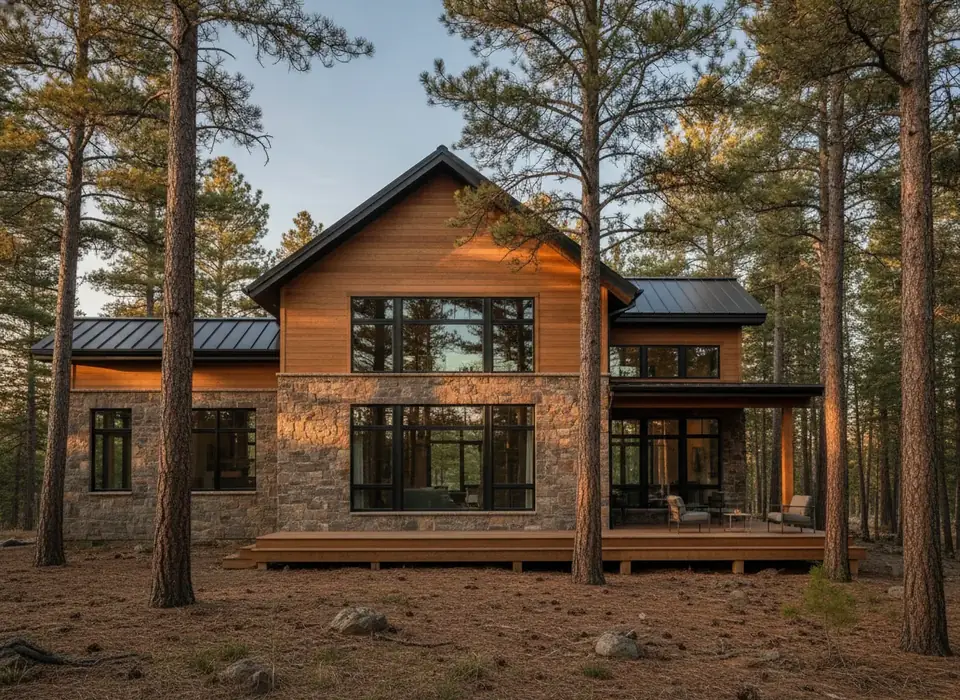
How Black Hills weather tests a window frame
Rapid City and the surrounding counties (Pennington, Meade, Lawrence and Custer) sit in IECC Climate Zone 6A. NOAA's 1991–2020 normals for Rapid City Regional Airport show about 7,252 heating degree days a year, roughly 174 nights at or below 32°F, and a January average low of 12.7°F. That is a long heating season, and the frame and glass are working against it for most of the year.
Cold alone is not the whole story. The Black Hills are known for chinook winds that can swing temperatures fast. The National Weather Service records that on January 22, 1943, Spearfish went from −4°F to 45°F in two minutes, and downtown Rapid City rose 49 degrees in 20 minutes the same morning. Swings like that are rare, but big daily ranges are common, and every swing makes the frame, the glass and the seals between them expand and contract.
Then add the sun. Rapid City sits at about 3,356 feet, and stronger high-altitude sun is widely cited as hard on exterior materials. That is a general building-science point rather than a local study, but it is a fair reason to ask about UV resistance, especially on south and west walls.
Finally, there is hail. Big storms hit the area on July 27, 2015, July 10, 2020, August 18, 2025 and June 22, 2026. No residential frame material is hailproof, and large hail breaks glass regardless of what holds it. Hail is covered in more depth in our guide to hail-damaged windows.
Vinyl vs fiberglass windows: side by side
| Factor | Vinyl | Fiberglass |
|---|---|---|
| Typical unit cost (Fixr, Jan 2026) | $350–$800 | $400–$1,500 |
| Movement with temperature | Expands and contracts more than glass | Moves at a rate close to glass |
| Frame profile | Usually wider frames, less glass area | Often slimmer, stiffer frames |
| Dark exterior colors | Available on some lines; ask how the color is applied and how it handles sun heat | Commonly offered; many can be repainted |
| Large openings and tall units | Fine for standard sizes; very large units may need reinforcement | Stiffness helps on large or tall units |
| Maintenance | Low; cannot be painted easily | Low; painted finishes may need touch-up over decades |
| Energy performance | Depends mostly on the glass package and install | Depends mostly on the glass package and install |
Typical published ranges, not quotes (Fixr Jan 2026). Black Hills installers' quotes vary. Installation labor typically adds $150–$300 per standard window (Fixr, Jan 2026).
Is vinyl or fiberglass better in cold weather?
For insulating value, neither frame wins by default. Both are poor conductors of heat compared with aluminum, and modern versions of each can be built with insulated chambers. In a Zone 6A winter, the bigger heat-loss decisions are the glass (double vs triple pane, low-E coatings, gas fill, warm-edge spacers) and how carefully the gap between window and wall is sealed.
Where fiberglass has a real edge is stability. Because it expands at a rate close to glass, the joints and seals see less stress as temperatures swing. That matters more on large windows, dark colors and walls that take full afternoon sun. Installers who favor fiberglass for chinook country usually make exactly this argument. It is a reasonable building-science point, not a guarantee that a fiberglass window will outlast a good vinyl one.
The glass package matters as much as the frame. The Black Hills are almost certainly in ENERGY STAR's Northern zone, where qualifying windows need a U-factor of 0.22 or lower; check the label on any window you are quoted. If you are weighing triple-pane glass too, read triple pane vs double pane windows and our page on energy-efficient windows.
What vinyl vs fiberglass windows cost in Rapid City
Published figures put a typical Rapid City window at $200–$1,200, with an average around $600 (EcoWatch, Jan 2025). Nationally, Fixr (Jan 2026) lists vinyl units at $350–$800 and fiberglass at $400–$1,500, before labor. On a one-story house with 10–15 windows, Fixr's whole-house range is about $8,000–$12,000, and a material upgrade moves you toward the top of that range or past it.
For a fuller breakdown and a calculator, see the window replacement cost guide for Rapid City.
When vinyl is the right call
- You want the most window for the budget, especially on a whole-house job.
- The windows are standard sizes in white or a light color.
- You are replacing 1980s–90s aluminum or early vinyl units in one of Rapid City's many pre-1980 homes and want a big comfort jump without the top price.
- It is a rental or a house you may sell in a few years.
Ask for a mid- or upper-tier line rather than the cheapest builder-grade unit. Wall thickness, welded corners and sash reinforcement vary a lot between vinyl product lines. More on that is on the vinyl replacement windows page.
When fiberglass earns its price
- You want dark exterior frames, which absorb more sun heat.
- The openings are large, such as picture windows or tall units facing a view.
- The walls take strong afternoon sun or full exposure to wind.
- You plan to stay a long time and want a frame that can be repainted.
The fiberglass, wood and composite windows page covers those materials, including wood-clad options, in more detail.
Questions to ask installers about either material
- Which product line is this, and what is the U-factor on the label for the exact glass package quoted?
- Is this a full-frame replacement or an insert into the existing frame, and why?
- How is the gap between window and wall insulated and sealed?
- For dark colors: how is the color applied, and is there any warranty limit on dark colors?
- What do the product warranty and the labor warranty each cover, and who backs each one?
- For a home built before 1978: are you an EPA Lead-Safe Certified Firm? Federal law requires it.
- What is your South Dakota contractor's excise tax license number? (You can verify it at 1-800-829-9188.)
Getting two or three written quotes, ideally including at least one for each material, is the clearest way to see the real price gap on your house. Our guide on how to compare window replacement quotes walks through it. When you are ready, the free quote form sends your project to independent local window companies. We are a free matching service, not a window company, and you are under no obligation to hire anyone.
Questions people ask
Are vinyl or fiberglass windows better for cold climates?
Neither frame wins on insulation alone; the glass package and installation drive most of the heat loss. Fiberglass expands at a rate close to glass, so it handles big temperature swings and dark colors with less stress on seals. Good vinyl is a solid, lower-cost choice for standard sizes.
How much more do fiberglass windows cost than vinyl?
Fixr's January 2026 ranges are $350–$800 per vinyl unit and $400–$1,500 per fiberglass unit, before labor of about $150–$300 per standard window. These are typical published ranges, not quotes. Black Hills installers' quotes vary with size, glass package and access.
Do vinyl windows crack or warp in South Dakota winters?
Quality vinyl windows are made for cold climates and are widely used across the northern Plains. Problems are more likely with thin, low-end frames, very large units or dark colors in strong sun. Ask the installer about frame wall thickness, reinforcement and any color limits.
Can hail damage vinyl or fiberglass frames?
Yes. Large hail can break glass in any frame and can crack, dent or scuff frames, exterior wraps and screens. No residential frame is hailproof. After a storm, photograph the damage and talk to your insurance agent before signing with anyone.